Blog · 21 October 2026 · 3 min read
Learning English by reading books, a practical method
Why reading builds vocabulary that sticks, how to pick a book at the right level, when to look a word up and when to let it go, and a twenty-minute routine you can keep.
Reading is the slowest-looking way to learn English and one of the most reliable. A textbook shows you a word once, in a sentence written to show it off. A novel shows you the same word twenty times, in twenty situations, said by people who are angry, tired or joking. That repetition in context is how words stop being translations and start being English.
Why reading works
When you read a story you care about, you meet each common word many times without trying. You also see grammar doing real work: how a question sounds polite, how tenses carry a flashback, which preposition follows which verb. Nobody explains it, but after enough pages you start to feel when something sounds wrong.
The catch is that this only happens when you understand most of what you read. If every line needs a dictionary, you are decoding, not reading, and the story stops pulling you along.
Choosing a book at the right level
A useful finding from reading research: Hu and Nation (2000) found that readers needed to know about 98 percent of the words on a page to follow a story comfortably without help. That sounds high, but it means roughly one unknown word in every fifty. On a typical page that is five or six new words, which is about right.
A quick test: read one page of a book you are considering. If you stop more than ten times, put it aside for later. If you stop two or three times and still want to know what happens next, you have found your book.
Good first books are often:
- Graded readers, written with a limited vocabulary for each level.
- Books you already know in your own language, so the plot carries you when the words do not.
- Classics with simple prose, such as Alice's Adventures in Wonderland, Aesop's fables or Sherlock Holmes stories, all free on Project Gutenberg.
Look up less, but look up well
Looking up every unknown word is the fastest way to stop enjoying a book. Skip the words you can guess from the sentence, and the ones that do not change what is happening. Look up a word when it keeps coming back, or when the scene stops making sense without it.
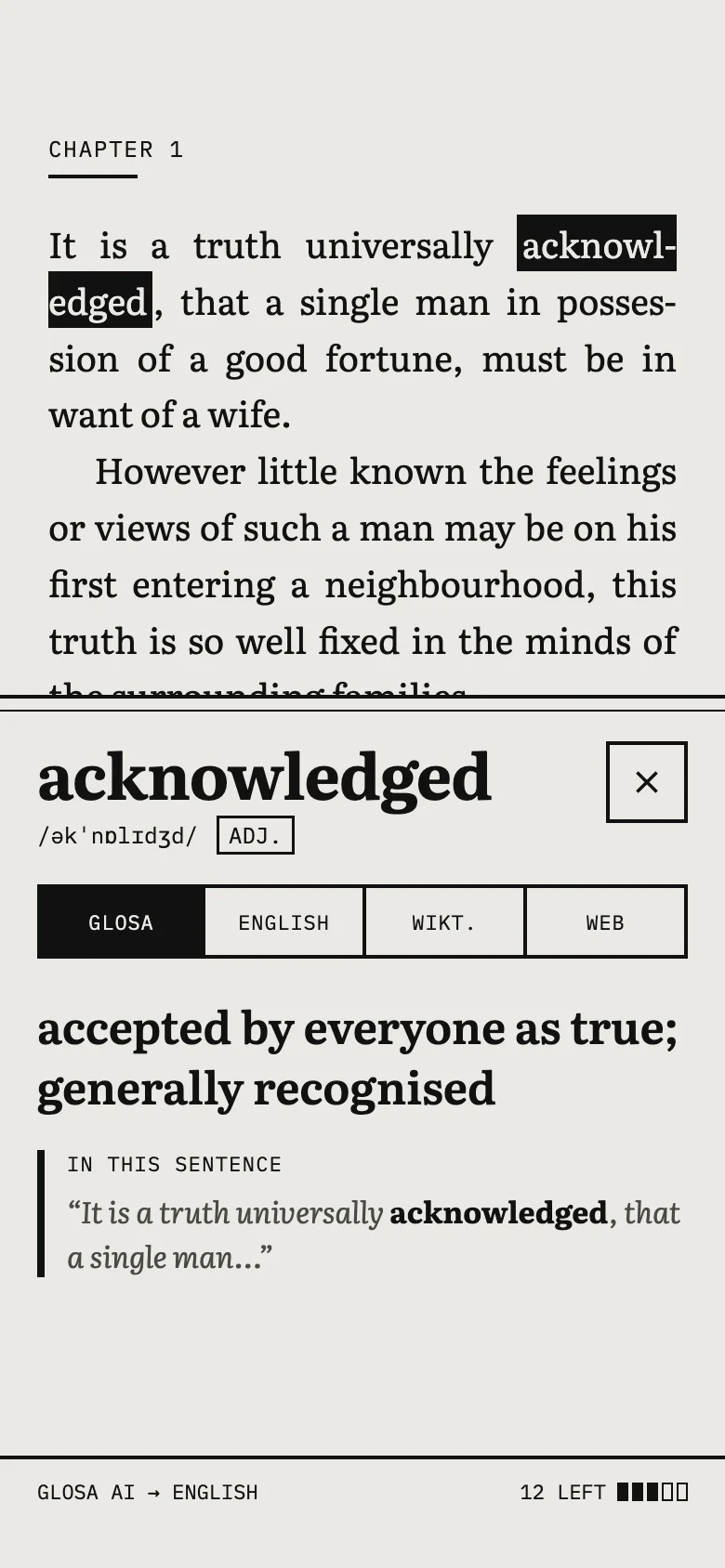
When you do look something up, the meaning in that sentence matters more than the dictionary's full entry. "Acknowledged" means one thing in "a truth universally acknowledged" and another in "she acknowledged the letter". A general dictionary gives you both and leaves you to choose. A lookup that reads the sentence can tell you which one the author meant.
Keeping a word list from your highlights
Words you looked up once are easy to forget. Highlight the sentence, not just the word, so you remember how it was used. Once a week, read back through your highlights and keep the five or six words you want to own. Say them in a sentence of your own. That small step does more than a list of a hundred words you will never open again.
A twenty-minute routine
- Fifteen minutes of reading, at a level where you look up only a few words per page. Do not reread for perfection; keep moving.
- Three minutes on your highlights: read the sentences again and say one new sentence for each word.
- Two minutes of listening: play the page you just read aloud and follow along. Hearing the rhythm of a sentence helps it stick.
Twenty minutes a day is about one short novel a month. After a year, that is twelve books' worth of English you met in context.
Where Glosa fits
Glosa is a reader built for this kind of reading. Double-tap a word and a small card shows what it means in that sentence, in your language, with a note when it is part of a phrase. The same card can translate the whole sentence when one word is not enough. Highlights keep the sentence, and you can export them to Markdown for your word list. Listen reads the page aloud with Apple or natural voices and marks the sentence it is reading, so you can follow along.